Five Plain-English Bullets → a Signature-Ready Contract Addendum, Drafted Against the Original Agreement
The deal changed in five bullets. The contract is dozens of pages the bullets never mention.
What was getting in the way.
Commercial terms change in conversation, a pricing update, a service swap, a dropped allotment, and someone has to turn that into contract language. The original agreement is an old scanned document with its own defined terms, its own numbering, and a clause that says changes only count in writing. Drafted casually, an addendum references the wrong sections, invents terms the contract doesn't define, or, worst, changes the economics in ways nobody noticed because nobody re-read the original paper against the new terms.
Context
Universal: the pattern applies to any amendment, addendum, renewal, or statement-of-work change where the new terms have to be reconciled against an existing signed document.
How the work runs.
- 01
Read the original paper, not a summary of it
The agent ingests the scanned agreement and its work order in full, the defined terms, the section numbering, the modification clause, before drafting a word. The addendum has to live inside the contract's own language to be worth signing.
- 02
Map each bullet to the clause it actually touches
Every plain-English change is traced to the specific section or work-order provision it amends or deletes, by name and number, so the addendum recites exactly what it replaces instead of gesturing at it.
- 03
Honor the contract's own rules for changing itself
The agreement requires modifications in writing; the addendum recites that requirement and is structured to satisfy it, so the change is enforceable rather than a friendly memo.
- 04
Re-run the economics against the baseline
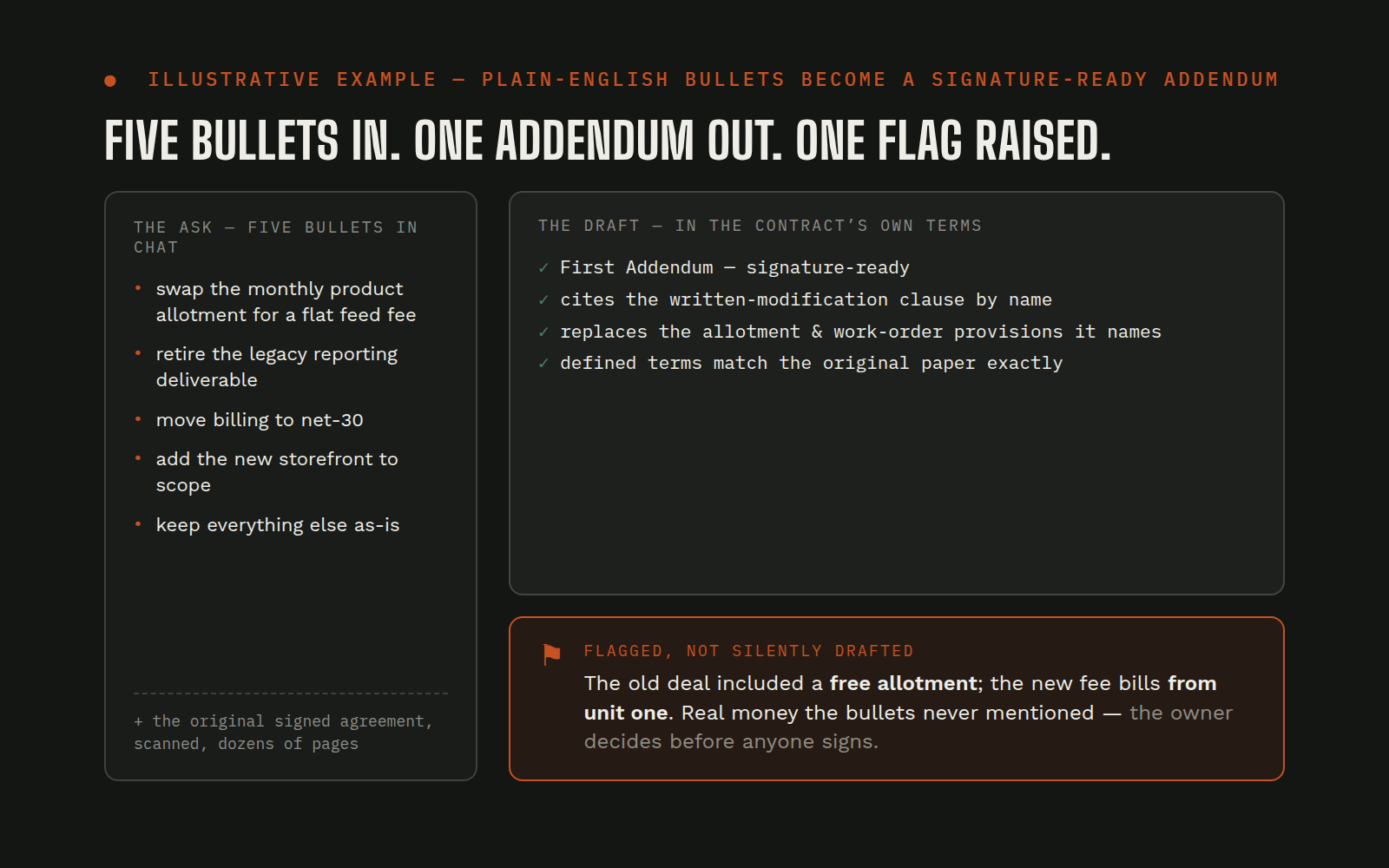
The agent checks what the old terms actually provided before the new terms replace them. Here it caught a real change the bullets never mentioned: the old agreement included a free allotment before a per-unit fee kicked in, and the new fee structure starts billing from the first unit. That's a priced consequence, not a wording detail.
- 05
Flag the finding; let the human decide
The discovered change is surfaced to the owner alongside the draft, flagged, not silently drafted in and not silently drafted around. The human decides whether that's the intent before anything goes out for signature.
Evidence from the workflow.
Each system has a role.
intake (the baseline being amended)
Original agreement + work order (scanned)
action (the addendum, in the contract's own defined terms)
Drafting layer
intake (the owner's intent, in plain English)
Change-bullet brief
record of truth (the flagged economics call is a human decision)
Owner review
Why this is Coworker.
Takes assignments and reports back. You hand it work, it prepares and returns a result.
- 01
The agent drafts; humans review and sign. Every cited clause is traceable to the original document. Economic consequences the bullets didn't state are flagged to the owner as findings, never resolved unilaterally: the agent neither sneaks the change in nor quietly drafts around it.
Impact / Outcomes
Five conversational bullets become a signature-ready addendum that cites the correct clauses by name and satisfies the agreement's own written-modification requirement.
A real economic shift hiding between the old terms and the new ones, a free allotment that quietly disappears, is caught and flagged before signature, instead of being discovered on the first invoice.
The drafting hours (and the re-read of an old scanned agreement nobody wanted to do) collapse into a review pass.
Find where a workflow like this fits.
Start with the systems, work, constraints, and authority already present in your operation.