Google Ads Prospect Audit: Ad Account + Website Read in One Pass, Verdict the Same Afternoon
"What do you think of our account?" is usually a multi-day, two-person answer. It doesn't have to be.
What was getting in the way.
A prospect grants Google Ads access and asks for an assessment. The traditional audit splits across two people and several days: one combs the ad account screen by screen, another reviews the website, and the findings get reconciled into a deck sometime next week. Meanwhile the budget keeps spending, and the most expensive problems (wrong network, fake conversions, broken policy pages) are exactly the ones a screen-by-screen skim tends to miss.
Context
Universal: the pattern applies to any ad-account assessment: new prospects, inherited accounts, quarterly health checks, pre-engagement due diligence.
How the work runs.
- 01
Pull the account through the API, not the UI
A read-only pull covers campaigns, networks, keywords, conversion actions, and spend distribution in one sweep: the whole account as data, instead of a sampled skim of screens.
- 02
Crawl the site in parallel
A read-only crawl walks the landing pages, the conversion paths, and the policy pages (privacy, terms, refund, shipping), because ad performance claims mean nothing if the site can't receive or track the traffic.
- 03
Follow the spend to where it actually goes
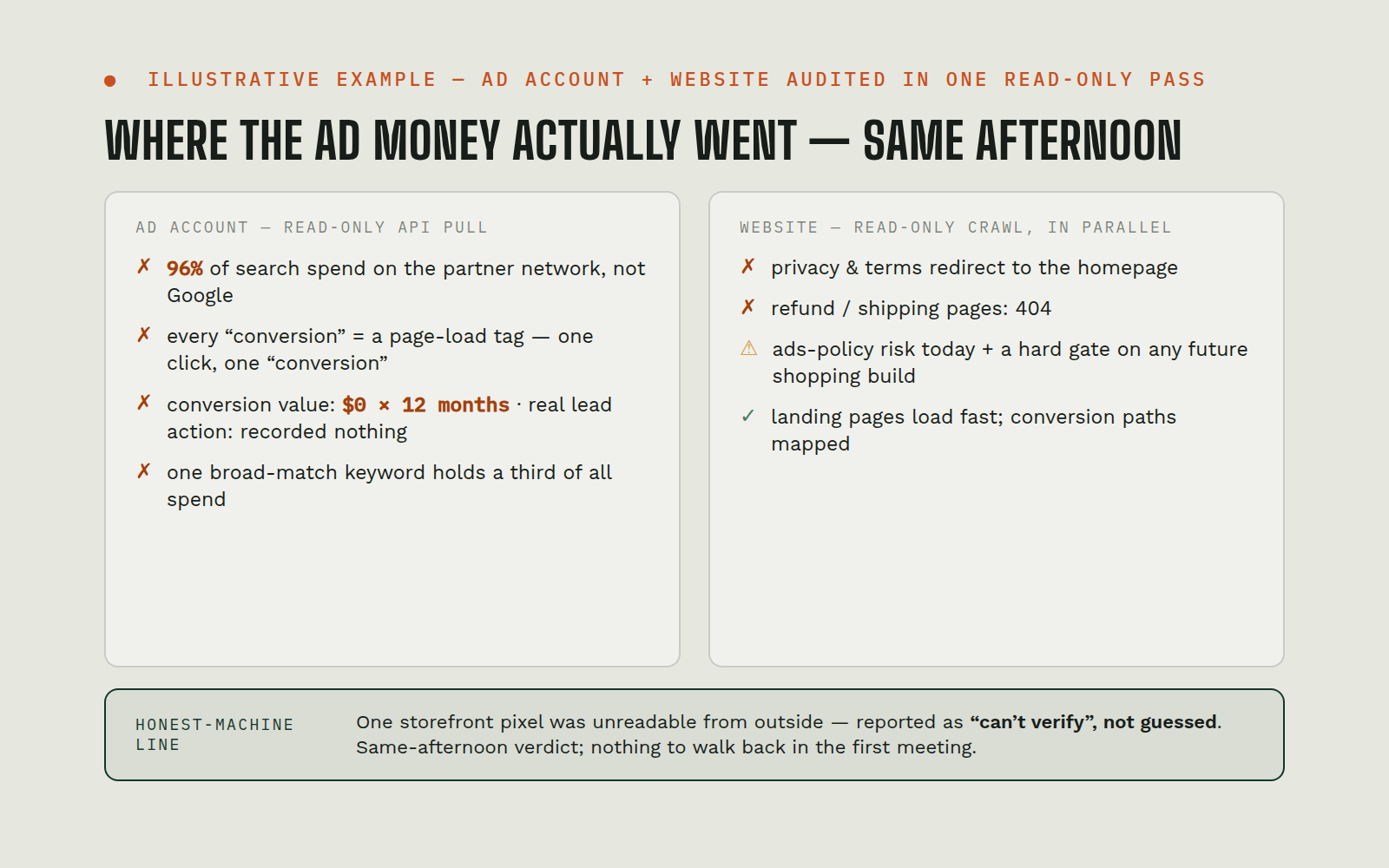
The pass found the large majority of search spend landing on the partner network rather than Google itself, and roughly a third of total spend concentrated on one broad-match consumer keyword: structural findings a surface skim reads right past.
- 04
Test what "conversion" actually means in this account
Every recorded conversion traced to a hardcoded page-load tag on landing pages, one click, one "conversion", so automated bidding had been optimizing toward the cheapest possible click. Conversion value: zero for twelve consecutive months. The one action representing a real lead had recorded nothing against tens of thousands of paid clicks.
- 05
Say what can't be proven, out loud
The crawl was HTML-only, so a storefront pixel it couldn't read gets flagged as unverified: the report says "this might contain purchase tracking we can't see from outside" rather than letting the team tell a prospect "purchases are untracked" and be wrong in the first meeting. Broken policy pages (redirects and dead links) are flagged as both an ads-policy risk now and a gate on future shopping campaigns.
Evidence from the workflow.
Each system has a role.
intake (the account as data, read-only)
Google Ads API
intake (landing pages, conversion paths, policy pages)
Website crawler
signal (spend concentration, network split, conversion-action tracing)
Analysis layer
action (good/bad/fix, with unverifiable items labeled honestly)
Audit report
Why this is Coworker.
Takes assignments and reports back. You hand it work, it prepares and returns a result.
- 01
Access is read-only on both surfaces: nothing in the account or on the site is changed. Claims in the report are traceable to pulled data or crawled pages; anything the pass couldn't verify is labeled as such rather than asserted. The audit goes to the team, and humans decide what reaches the prospect.
Impact / Outcomes
A multi-day, two-person audit collapses into a same-afternoon verdict covering both the ad account and the site it feeds.
The findings that matter most, spend on the wrong network, conversions that were page loads, a year of zero conversion value, policy pages that could trip enforcement, surface before the first strategy conversation, not after.
The report distinguishes verified findings from unverifiable ones, so nothing said to the prospect has to be walked back.
Find where a workflow like this fits.
Start with the systems, work, constraints, and authority already present in your operation.