LinkedIn Ads Launch: First-Party Traffic Quality Audit Catches a Placement Leak
Within hours of launch, verify independently, using the site's own first-party, server-side tracking, built by the same agent in an earlier workflow, whether the clicks being paid for were real prospects or junk traffic.
What was getting in the way.
The team launched its first paid campaign on an unfamiliar ad platform (LinkedIn Ads). Clicks started flowing immediately, but platform dashboards only show what the platform wants to show, and a new-platform launch is exactly when budget leaks go unnoticed for weeks.
Context
A small team running its first paid social campaign on LinkedIn to promote three service lines, with all site analytics captured first-party in its own database.
How the work runs.
- 01
Campaign goes live in the evening
The team asks the agent next morning how the ads are doing on-site.
- 02
Agent queries tracking it configured itself
In a prior workflow the agent had designed and deployed the site's first-party analytics: page views, sessions, engagement and conversions captured into the site's own database server-side, unaffected by ad-blockers or stripped referrers. No third-party analytics product in the loop.
- 03
Agent cross-checks platform claims against that first-party data
Every ad click is UTM-tagged per creative, so click volume, landing pages and devices get verified against what the ad platform reports.
- 04
Agent spots the quality anomaly
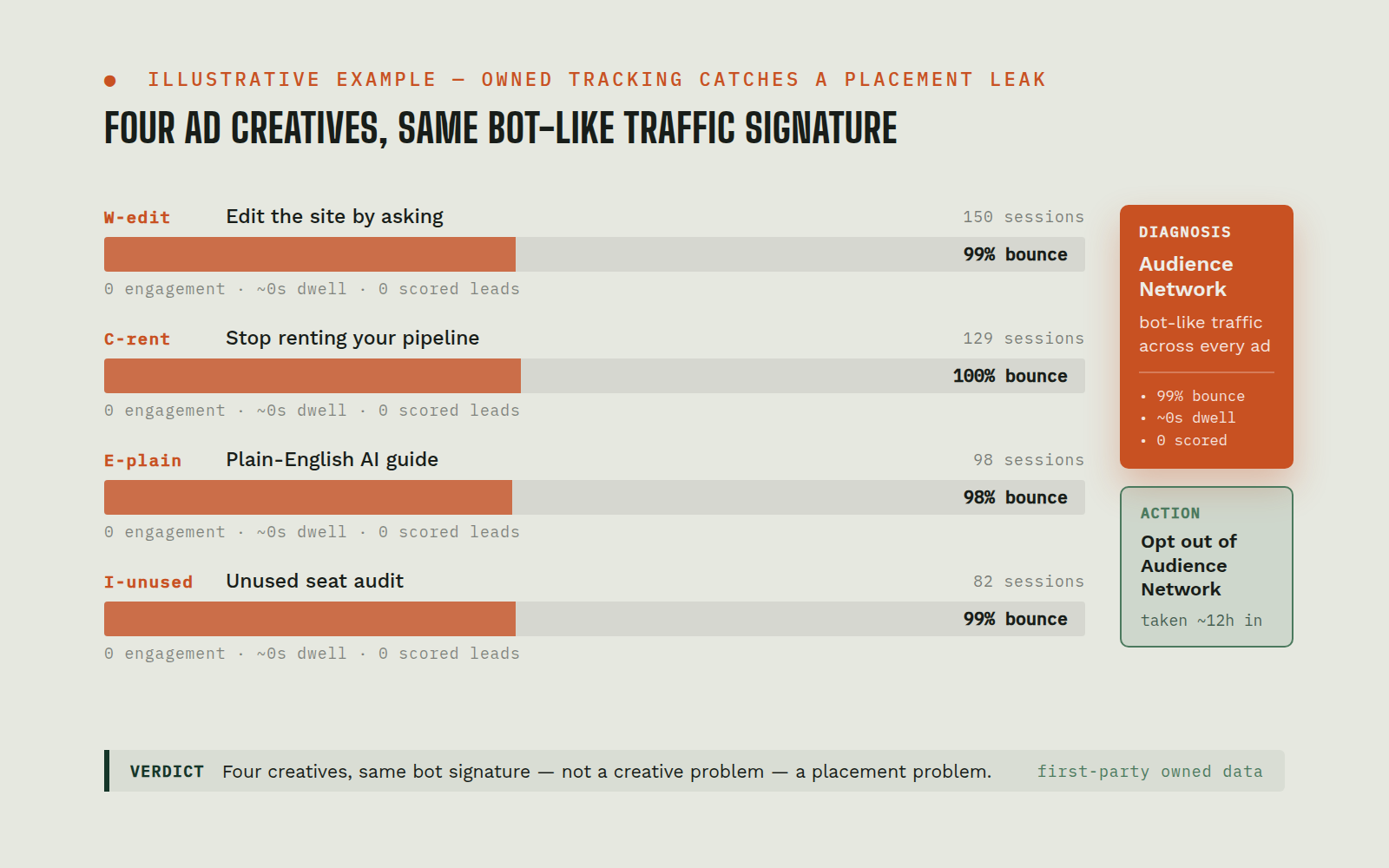
Near-100% bounce, ~1 page per session, seconds-long visits, zero engagement events, and none of the clicks converting. Volume looked healthy; behavior said otherwise.
- 05
Agent traces the source
Referrer analysis shows roughly a third of ad sessions arriving through third-party ad-exchange domains rather than the platform itself: the signature of the platform's off-network "audience network" placements, notorious for cheap low-intent clicks.
- 06
Fix identified and applied ~12 hours from launch
Restrict placements to the platform's native feed. The budget leak is closed before it compounds; per-ad comparisons resume on clean traffic.
Evidence from the workflow.
Each system has a role.
Campaign and placement settings where the fix was applied
LinkedIn Ads
Page-view, session and conversion capture into the site's own database, designed and configured by the agent
First-party server-side analytics
Where the question was asked and answered
Slack
Session-level queries behind the analysis
PostgreSQL
Why this is Coworker.
Takes assignments and reports back. You hand it work, it prepares and returns a result.
- 01
The agent reads data and recommends; placement changes in the ad account are made by a human. All analysis runs on the team's own first-party data, stored in the team's own database.
Impact / Outcomes
Placement leak diagnosed and fixed ~12 hours from launch, not weeks into the flight
The measurement stack is owned, not rented: the agent audits ad spend with tracking it built itself, instead of trusting the ad platform to grade its own homework
Independent per-creative read on every ad click, with quality metrics (bounce, dwell time, pages/session) separating "most-clicked" from "best-performing" for every future ad decision
Find where a workflow like this fits.
Start with the systems, work, constraints, and authority already present in your operation.