Sales Collateral Drafting: branded one-pagers, tiered case studies, generated imagery
Forward-ready collateral on demand, right brand, right claims, right disclosure level.
What was getting in the way.
Sales collateral was a bottleneck: a branded one-pager meant a designer's queue, and case studies stalled on the question "what are we allowed to disclose?", so they mostly didn't get made. Different prospects need different disclosure levels, and hand-maintaining multiple versions of the same story was untenable.
Context
Case-study subjects include local service businesses such as a moving company and a dog-training academy (anonymized or approval-gated as required per tier).
How the work runs.
- 01
Trigger
sales asks for an asset ("one-pager for X," "case study we can send this prospect").
- 02
Agent gathers existing brand assets
Agent gathers existing brand assets (logos, exact palette), never invents styling.
- 03
Assembles the piece (HTML →
Assembles the piece (HTML → PDF for one-pagers; web pages for case studies), generating supporting imagery where needed.
- 04
Case studies build as one
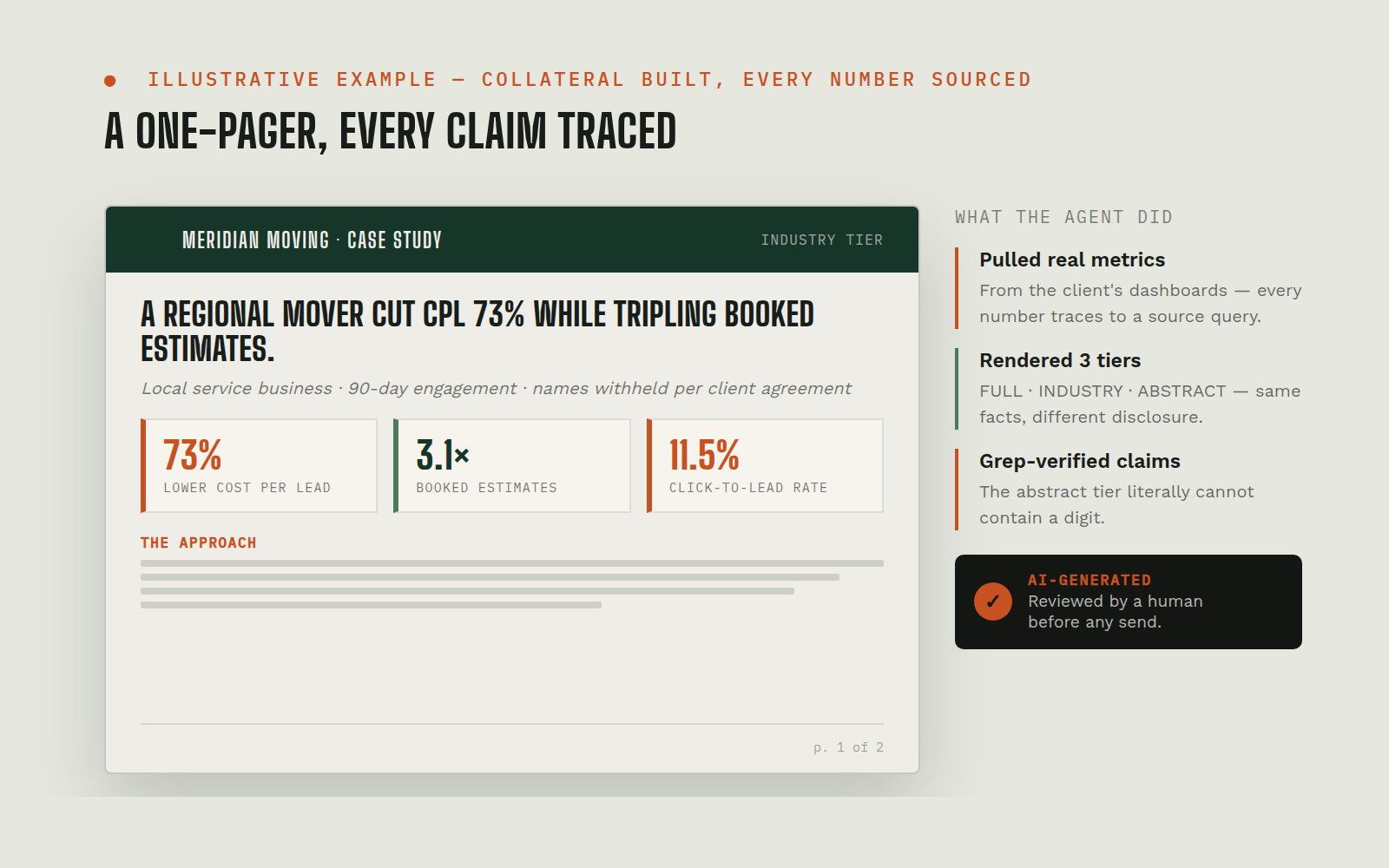
Case studies build as one design with three disclosure tiers: FULL (absolute numbers), RELATIVE (multipliers/percentages only), REDACTED (no numbers, qualitative), from a single verified content pack where every number traces to a source query.
- 05
QA pass
automated content checks per tier (e.g., the redacted tier must contain no digits anywhere) plus visual review.
- 06
Outcome
a polished, verifiably-claimed asset delivered in chat, with a confidentiality check before anything ships.
Evidence from the workflow.
Each system has a role.
Intake
Brand asset library
Action
PDF/web build tooling
Record of truth
Case-study catalog
Action
Image generation
Why this is Copilot.
Helps a person work faster. You ask, it answers. All actions belong to a human.
- 01
Standing disclosure ceiling applies to every tier (no client tenure, no calendar dates, no dollar figures, no data-source attribution). Publication of client case studies is approval-gated by a human.
Impact / Outcomes
Collateral turnaround dropped from a design-queue wait to same-conversation delivery.
Disclosure risk is engineered out: each tier is grep-verified against its rules (the redacted tier literally cannot contain a number).
Every claim traces to a source query, nothing invented (house rule).
Find where a workflow like this fits.
Start with the systems, work, constraints, and authority already present in your operation.