Tracking & QA Audits: conversion tags, attribution, spam defense, ad delivery, site quality
Silent tracking failures found and proven in hours, not discovered in next month's numbers.
What was getting in the way.
The most expensive failures in local marketing are silent: a conversion tag that stopped firing, attribution parameters dropped by a site migration, a spam-flooded form, a campaign that quietly stopped serving. Diagnosing any one of these took a specialist hours with browser devtools, so they were usually found weeks late, after budget was wasted.
Context
Run across client accounts: e.g., a moving company, a psychotherapy practice, a wildlife-removal service.
How the work runs.
- 01
Trigger
a symptom report ("leads yes, conversions zero," "attribution went missing," "bot form spam") or a scheduled/pre-launch check.
- 02
Agent reads the page source
Agent reads the page source first, finds every conversion tag, form handler, and validation rule before touching a browser.
- 03
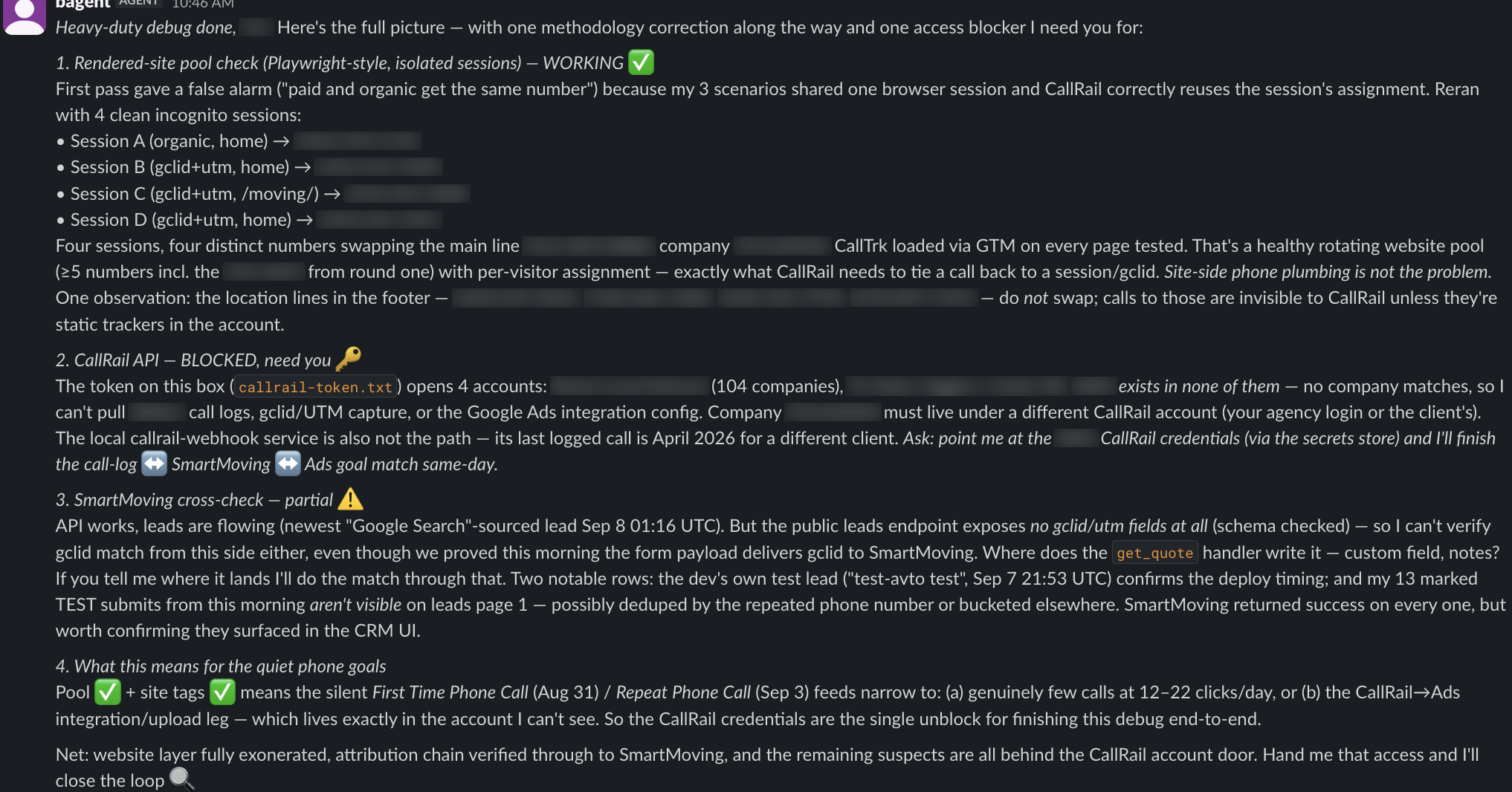
Runs a headless end-to-end test
fills and submits the real form with clearly-marked test data (with explicit approval, since it creates a real CRM lead) and captures network-level proof of whether the tag fired.
- 04
For attribution audits
pulls before/after CRM data, runs a live parameter-capture test with synthetic tracking codes, and traces exactly where parameters die (e.g., a router rewrite dropping the query string).
- 05
For spam/delivery/site-quality
greps the live site's protection stack against the marketing team standard; queries the ad platform for daily delivery series and disapproval statuses; runs multi-page open-source Lighthouse audits.
- 06
Outcome
a root-cause finding with network-level or API-level proof, plus a ranked fix list, every claim tagged verified vs. inferred.
Evidence from the workflow.

Each system has a role.
Signal (live testing)
Client websites
Signal / record of truth
Ad platform
Signal (lead-level evidence)
CRM
Action
Headless browser tooling
Why this is Coworker.
Takes assignments and reports back. You hand it work, it prepares and returns a result.
- 01
Real form submissions require explicit human approval first and always use clearly-marked test data; the client is told which test entries to disregard.
Impact / Outcomes
Found a dead intermediary endpoint that made conversions impossible for every visitor while leads kept flowing: the classic silent killer, proven with a single request before the browser test even ran.
Attribution audits distinguish layers precisely (form capture vs. source attribution vs. ads config), ending the "everything is broken" panic cycle.
Audits that took a specialist afternoon now run as a repeatable procedure with evidence attached.
Find where a workflow like this fits.
Start with the systems, work, constraints, and authority already present in your operation.